
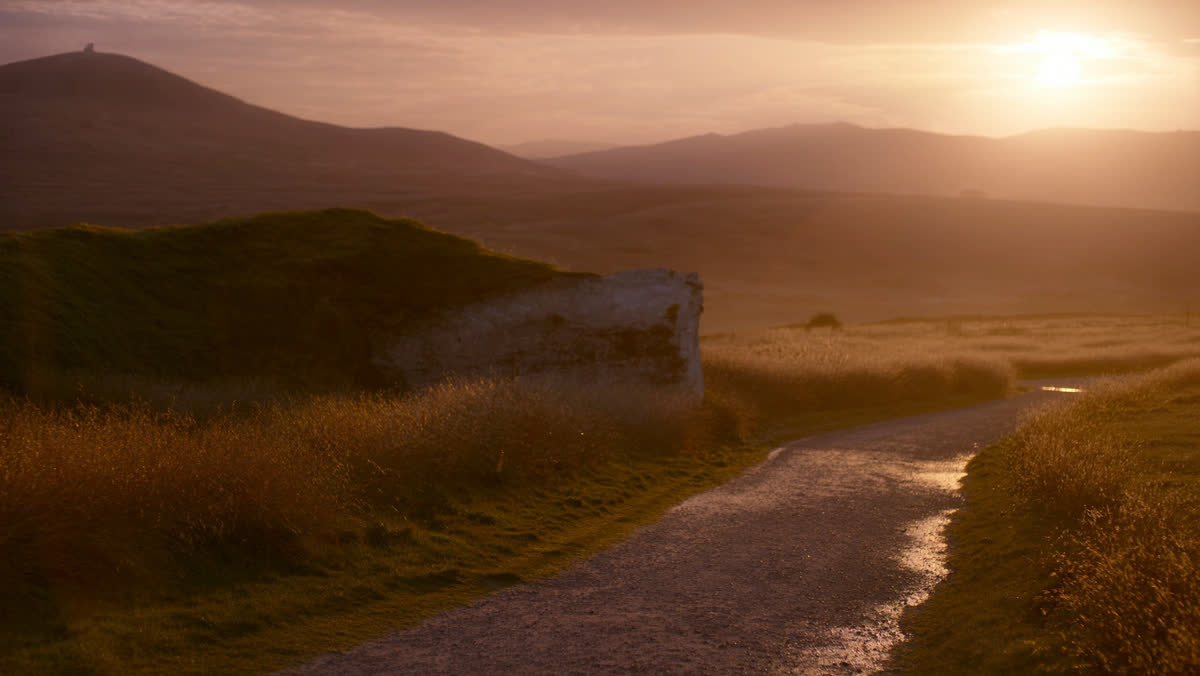
To walk with God means to live your ordinary days in his company, moving in the direction he is moving, at the pace he sets. Scripture almost never describes this as a mountaintop event. It describes a road: two people going the same way, over years, in conversation.
The verses below are the ones the Bible uses to describe that road. Read slowly. They are less about religious performance than about companionship, agreement, and staying in step.
What does it mean to walk with God?
The first person the Bible describes this way is Enoch, and the description is remarkably plain.
Enoch walked with God, and he was not found, for God took him. Genesis 5:24 (WEB)
Notice what the text does not say. It does not say Enoch preached to thousands or performed miracles. Genesis 5 is a genealogy, a list of men who lived and had children and died. Enoch’s line breaks the pattern only by adding that he walked with God for three hundred years while raising a family. His faithfulness happened inside an ordinary life, alongside the diapers and the harvests and the funerals of his relatives.
That should be a relief to you. Walking with God is not a separate life you have to construct on top of the one you already have. It is the life you already have, lived in his presence.
The prophet Micah puts the same idea in three practical clauses.
He has shown you, O man, what is good. What does Yahweh require of you, but to act justly, to love mercy, and to walk humbly with your God? Micah 6:8
Justice is how you treat people who cannot repay you. Mercy is how you treat people who have wronged you. Humility is how you treat God. Those three fit in one sentence because they belong together.
Why does walking with God require agreement?
Amos asks a question so simple it can be easy to skip past.
Do two walk together, unless they have agreed? Amos 3:3
Two people walking together have settled at least two things: where they are going and how fast. If you want to go east and your friend wants to go west, the friendship does not end, but the walk does. You are now two people standing in a field arguing.
Most of the friction people feel in their spiritual life traces back here. It is not that God is distant. It is that there is a real disagreement neither party has named yet. A grudge you have decided to keep. A habit you would rather not surrender. A plan for your life you have not actually offered to him.
Naming the disagreement is not a failure of faith. It is the beginning of the conversation that gets you walking again.
What Bible verses talk about walking with God?
These are the passages worth memorizing if you want the picture in your bones.
Show me your ways, Yahweh. Teach me your paths. Guide me in your truth, and teach me, For you are the God of my salvation, I wait for you all day long. Psalm 25:4-5
and when you turn to the right hand, and when you turn to the left, your ears will hear a voice behind you, saying, “This is the way. Walk in it.” Isaiah 30:21
As therefore you received Christ Jesus, the Lord, walk in him, rooted and built up in him, and established in the faith, even as you were taught, abounding in it in thanksgiving. Colossians 2:6-7
If we live by the Spirit, let’s also walk by the Spirit. Galatians 5:25
But if we walk in the light, as he is in the light, we have fellowship with one another, and the blood of Jesus Christ, his Son, cleanses us from all sin. 1 John 1:7
Read them together and a pattern emerges. Walking with God involves asking for direction rather than assuming it. It involves listening for correction while you are already in motion, since Isaiah’s voice comes from behind, once you have started to turn. It involves continuing the same way you began, by trusting Christ rather than by proving yourself. And it involves honesty, because light is where fellowship happens.
How do I know if I’m going the right direction?
People often want a sign before they will take a step. Isaiah 30:21 suggests God more often speaks into movement than into paralysis. The correction arrives as you veer, the way a parent’s voice reaches a child who has wandered a few feet down the wrong aisle.
So when you are unsure, use the tools you have been given rather than waiting for something more dramatic.
- Scripture. Most of what God wants from you this week is already written down and not in dispute. Start there before you start looking for a personalized word.
- Character over outcome. A door that opens is not automatically a door God opened. Ask what a choice will make of you, not only what it will get you.
- Wise people who know you. Not the friends who agree with you fastest. The ones who have watched you make decisions for years.
- Time. Urgency that will not survive a night of sleep and a morning of prayer is usually pressure, not guidance.
What if I’ve fallen out of step?
Almost everyone reading this has a stretch of road they walked alone. Months when prayer stopped. A season when church became a building you drove past.
The Bible’s response to that is not a lecture. It is an invitation to turn around and keep going, and the turning is usually less complicated than you fear. Colossians says to walk in Christ the same way you received him, which was not by earning anything. If you came in by grace, you come back by grace.
You do not need to reconstruct the last three years first. You need one honest sentence today.
How do I start walking with God this week?
Direction matters more than intensity here. A short walk you actually take beats a long one you keep planning.
- Pick a fixed time, not a fixed feeling. Ten minutes attached to something you already do every day, like the first coffee or the drive home. Feelings will not schedule this for you.
- Read one book slowly. Try the Gospel of Luke, a chapter at a time. Watching Jesus move through ordinary rooms will teach you more about walking with God than a stack of advice.
- Name the disagreement. Ask honestly where you and God are not going the same direction right now. Write it down. That sentence is your real prayer list.
- Talk to him in the middle of things. In traffic, in the hallway before a hard meeting, at the sink. The Bible’s picture of walking assumes continuous, unremarkable conversation.
- Do one act of mercy a week. Micah puts justice and mercy in the same breath as walking humbly for a reason. Faith that never reaches another person is hard to sustain.
- Let someone see you. Fellowship in the light, as John describes it, needs at least one person who knows the unedited version of your life.
What if the walk feels dry?
Dryness is normal, and it is not evidence that God has left. Long faithfulness includes flat stretches. Keep the practices even when the warmth is gone, the way you keep eating during a season when food tastes like nothing.
That said, be honest about what you are dealing with. If the flatness is heavy and constant, if it has settled into your sleep and your appetite and your ability to care about anything, that may be depression rather than a spiritual dry spell. Faith and professional care are not in competition. Talk to your doctor or a counselor and keep praying. If you are having thoughts of harming yourself, call or text 988 in the United States to reach the Suicide and Crisis Lifeline. That call is not a lack of faith. It is the same instinct that makes you call for help when a bone breaks.
A prayer for walking with God
God, I want to go where you are going. Show me the places I have quietly decided to go my own way, and give me the honesty to say them out loud instead of managing them alone. Teach me to hear you while I am moving. When the road is dull, keep me on it. When I wander, turn me around gently. Thank you that you have walked with ordinary people through ordinary years, and that you are willing to walk with me. Amen.
Where to go from here
Read Genesis 5 in one sitting this week. It takes about four minutes, and the effect of that long list of names is the point. Generations of people lived and died, and one line simply says a man walked with God. That is available to you too, in the life you already have, starting today.
Then pick up Psalm 25 and pray verses 4 and 5 in your own words for seven days. Asking to be taught is the most reliable place any walk with God begins.