
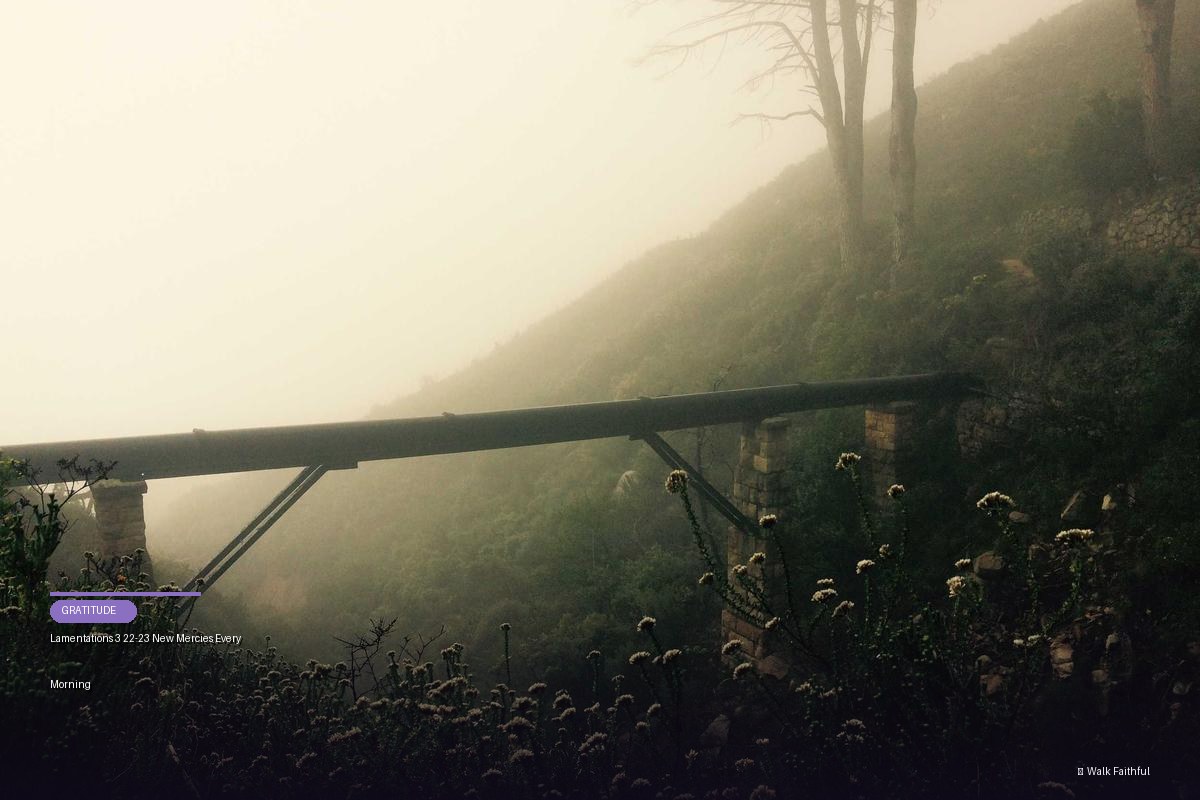
Lamentations 3:22-23 promises a daily resupply of God’s covenant kindness, and it makes that promise from inside a burned city. The man who wrote it had watched Jerusalem fall, and four verses earlier he had said his hope in God was finished. These two lines claim that the mercy keeping him alive had not run out overnight and would not run out tomorrow. They do not claim tomorrow will be easier.
What do the two verses actually say?
The phrasing most people know comes from older translations, fixed in memory as much by a hymn as by a translator. The World English Bible renders the lines this way.
It is because of Yahweh’s loving kindnesses that we are not consumed, because his compassion doesn’t fail. They are new every morning; great is your faithfulness.
Lamentations 3:22-23 (WEB)
Notice how verse 22 is built. Two negatives carry it: we are not consumed, his compassion does not fail. The poet never says the mercy is abundant, or warm, or that he can feel it. He says it has not been used up, and that the reason he is still breathing after the siege is not his own resilience. The Hebrew word behind “loving kindnesses” is hesed, the loyal, promise-bound affection God attached himself to when he made a covenant with this people. It is love that was sworn rather than merely felt. A feeling can evaporate in a night. A promise cannot.
Who wrote this, and when?
Lamentations is five poems written over the ruins of Jerusalem after the Babylonian army broke the city in 586 BC. The temple was ash, the wall was down, and the survivors were starving in the streets. Four of the five poems are alphabet acrostics, and chapter 3 is the strictest, three lines to a letter. Grief that formal is grief somebody sat down and worked at. It was not written in the first week.
They are not a bright fragment imported from a happier book. They sit in the darkest chapter, and this is the same speaker a few lines earlier.
You have removed my soul far off from peace; I forgot prosperity. I said, My strength is perished, and my expectation from Yahweh.
Lamentations 3:17-18 (WEB)
His expectation from God is gone. That is what a man writes when he has stopped waiting for God to act. Whatever verse 22 is, it is not the opinion of someone who was spared.
What changes in verse 21?
This I recall to my mind; therefore have I hope.
Lamentations 3:21 (WEB)
Nothing outside him has changed. No siege lifts between verse 20 and verse 21, no messenger arrives. The hinge of the whole book is one act of memory: he makes himself recall something he already knew and had stopped applying to his own case, and hope follows the recalling rather than causing it. The poem never claims he felt better. Hope here is a stance toward the future, not a mood in the present. Then he names what he still owns.
Yahweh is my portion, says my soul; therefore will I hope in him.
Lamentations 3:24 (WEB)
Portion is land language. When Israel divided Canaan the priestly tribe was given no territory, and God himself was named as their inheritance instead. The poet has lost his land, his city and his temple, and he reaches for the provision written for people who never held ground to begin with.
Why every morning, and not once and for all?
Because a daily ration is how God had fed these people before. In the wilderness the bread came down each day and could not be hoarded.
They gathered it morning by morning, everyone according to his eating. When the sun grew hot, it melted.
Exodus 16:21 (WEB)
Anything kept back overnight bred worms. The arrangement was inefficient on purpose: no reserve meant no way to stop asking. Jesus kept the same measurement when he taught his followers to ask for bread for the day, and Paul described the whole Christian life in the currency of Lamentations.
Therefore we don’t faint, but though our outward man is decaying, yet our inward man is renewed day by day.
2 Corinthians 4:16 (WEB)
Same accounting. Nothing stockpiled, nothing issued in advance, a supply sized to the day it was made for. It also explains something people quietly find embarrassing, that yesterday’s sense of God is no use to anyone this morning. It was never meant to be. It was yesterday’s portion, and it melted in the sun.
What does the passage not promise?
It does not promise the circumstances improve. Jerusalem lay in ruins for decades after these poems were finished. The mercy the poet counts on is the mercy that got him through the night, not one that rebuilt anything he could see.
It does not promise resolution either. The book refuses to end well.
Why do you forget us forever, And forsake us so long time? Turn us to yourself, Yahweh, and we shall be turned. Renew our days as of old.
Lamentations 5:20-21 (WEB)
That is nearly the last thing in the book, a question and a request with no answer printed underneath, and the final verse is bleaker still. Anyone quoting new every morning as a guarantee of a good day is quoting two verses out of a hundred and fifty-four; the rest is a complaint God has not yet answered.
And it does not promise you will feel the mercy. Mercy that carries a person through a night is not the same as mercy a person notices. If mornings are the worst hour of your day, if you wake with dread or cannot get out of bed and it has gone on for weeks, that is a described symptom of depression and of heavy grief, not a shortage of faith. Tell a doctor or a licensed counselor and treat it as the medical matter it is. In the US you can call or text 988 at any hour if you are thinking about ending your life, and reach SAMHSA at 1-800-662-4357 if drinking or drugs have become how you get through the morning. Treatment is the right response to an illness, and this passage was never offered as a replacement for one. The poet was not stoic about how bad it had become. He wrote it down at length and left it in the Bible.
How do you actually use these verses in the morning?
Follow the poem’s own order, which is not the order the verse usually gets used in.
Say the complaint first. Chapter 3 spends twenty verses on wormwood and gall before it comes near mercy, and the complaint is specific: no peace, no strength, no expectation left. Skipping to verse 22 while the true sentence in your chest is verse 18 produces the flat, dutiful prayer that makes people give up praying altogether.
Then recall, deliberately, out loud if the house is empty. Recall is not the same as feeling. Say the thing the poet said: this has not consumed me, and his compassion has not run out. It is a claim about what has held so far, and it can be said in a level voice with no feeling attached.
Then take the day’s portion and stop there. Not the week, not the recovery, not the question of how this ends. The poet was never promised a rebuilt city and did not live to see one. He was promised enough loving kindness for the hours between now and dark, and then more of it at dawn, unearned, in a city that still smelled of smoke.
Walk Faithful is coming to iPhone
Guided prayer walks — Scripture, breath prayer, and quiet, for the walk you already take. Be first to know when it opens.
One email when the app opens. No spam, and you can unsubscribe any time.