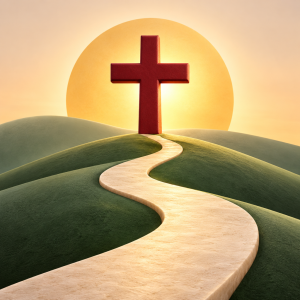
The tree of life in Revelation is part of what John is shown at the very end of his vision: it grows beside the river flowing from the throne of God, on both sides of the city’s street in the New Jerusalem, bearing fruit twelve times a year, its leaves given for the healing of the nations. Where it is now is the harder half of the question, and the honest answer is that Scripture never puts it on a map. Genesis closes the way to it. Revelation opens the way again inside a city that has not yet come down.
What does Revelation actually describe?
The scene is short, and almost every detail matters.
He showed me a river of water of life, clear as crystal, proceeding out of the throne of God and of the Lamb, in the middle of its street. On this side of the river and on that was the tree of life, bearing twelve kinds of fruits, yielding its fruit every month. The leaves of the tree were for the healing of the nations.
Revelation 22:1-2 (WEB)
Notice where the tree is standing. Not in a walled garden, not on a mountain, not behind a gate. It is in the middle of the street, the way a plane tree stands over a city sidewalk, with a river running down the same road. The last picture the Bible gives of the redeemed world is not a return to wilderness. It is urban and cultivated at once, a city with an orchard down its main road.
John writes tree in the singular, then describes it growing on both banks, which is why readers have argued for centuries over whether he means one tree, a row of them, or a kind of tree. The text does not settle it. What John insists on is fruit every month rather than one harvest a year, and foliage with a purpose beyond shade.
Why does the same tree appear on the first pages of Genesis?
Because Revelation is deliberately finishing something Genesis started. The tree shows up in the second chapter of the Bible, unremarkably, in a list of what God grew.
Out of the ground Yahweh God made every tree to grow that is pleasant to the sight, and good for food, including the tree of life in the middle of the garden and the tree of the knowledge of good and evil.
Genesis 2:9 (WEB)
It sits there without commentary. No one is forbidden to eat from it. The prohibition in Eden attaches to the other tree, and the tree of life goes unmentioned again until after the fruit is taken and the damage is done.
Yahweh God said, “Behold, the man has become like one of us, knowing good and evil. Now, lest he reach out his hand, and also take of the tree of life, and eat, and live forever…” Therefore Yahweh God sent him out from the garden of Eden, to till the ground from which he was taken.
Genesis 3:22-23 (WEB)
Then comes the detail most people remember: cherubim posted east of the garden with a flaming sword turning every way, guarding the road back. God never finishes the sentence about what would happen if the man ate and lived forever in that condition.
Christians read that barrier differently. Some hear judgment in it, others hear mercy on the grounds that endless life inside a ruined life is no gift. The text does not label it, and a reader is not obliged to choose. What is clear is the shape of the story: something freely available at the beginning was fenced off in the middle, and the fence is gone at the end.
So where is the tree of life right now?
Scripture gives no coordinates and never asks anyone to look. Genesis names four rivers around Eden, two we can still identify and two we cannot, and that half-recognizable geography has sent explorers into southern Iraq, eastern Turkey and the Persian Gulf for centuries. None of them found a garden. No claim about locating the tree of life has ever held up, and no verse suggests one should.
The one line that speaks of the tree in present terms is a promise Jesus makes to a struggling church, and it locates the tree by relationship rather than by region.
He who has an ear, let him hear what the Spirit says to the assemblies. To him who overcomes I will give to eat of the tree of life, which is in the Paradise of my God.
Revelation 2:7 (WEB)
The Paradise of my God describes where God is, not a country you could fly to. The tree is not lost property. It is not buried under sand, hidden in a jungle, sealed in a reliquary, or waiting for the right expedition. If someone is selling you oil, bark, seeds or a supplement from it, they are selling something the Bible declined to locate.
Is the tree literal or a symbol?
Serious Christians land in different places, and the options are worth naming plainly rather than pretending one is obvious. Some read an actual tree in an actual renewed creation, on the reasoning that the new earth is physical, that resurrected bodies eat, and that the river and the street in the same sentence are not usually treated as figures of speech. Some read an image of Christ, noting that the New Testament repeatedly calls the cross a tree, so that the man who dies on a tree gives the life the first tree withheld. Some read an image of unbroken access to God, the exact reversal of the flaming sword, in which case the point is not botany but the end of exile.
The phrase carried figurative weight long before John used it. Proverbs applies it to things that are plainly not trees.
Hope deferred makes the heart sick, but when longing is fulfilled, it is a tree of life.
Proverbs 13:12 (WEB)
That does not prove Revelation is figurative. It does mean anyone who insists the question is settled is claiming more than the text gives. A reader can hold the promise firmly and the mechanics loosely.
What does healing of the nations mean if there is no more pain?
This is the sharpest question in the passage, because a chapter earlier John has already ruled out the thing the leaves would seem to be for.
He will wipe away from them every tear from their eyes. Death will be no more; neither will there be mourning, nor crying, nor pain, any more. The first things have passed away.”
Revelation 21:4 (WEB)
If death and pain are finished, healing appears to have nothing left to do. The likeliest answer is that John is drawing on Ezekiel, who saw water running out from under the temple and trees growing along both banks of it.
By the river on its bank, on this side and on that side, shall grow every tree for food, whose leaf shall not wither, neither shall its fruit fail: it shall produce new fruit every month, because its waters issue out of the sanctuary; and its fruit shall be for food, and its leaf for healing.
Ezekiel 47:12 (WEB)
In Ezekiel the leaves are not emergency medicine. Everything the water touches turns from dead to living, from salt to fresh, and healing there means wholeness sustained rather than injuries treated. John adds one word Ezekiel does not: nations. The peoples who spent the whole biblical story at war with each other and with God are the ones the leaves are for.
It is worth saying flatly that those leaves are not a present-tense treatment plan. Nothing here suggests a sick person should pray instead of seeing a doctor, or that faith substitutes for care. If you are ill, get treated. The vision is about the world God is bringing, not a remedy available this week.
What does this promise, and what does it not promise?
It does not promise that Eden can be found, recovered or reverse-engineered. It does not promise a date. It does not promise that anyone reading this will be spared illness, grief or the ordinary wearing down of a body. Revelation was written to churches under pressure, and it did not spare them either.
What it promises is narrower and heavier. The barrier that went up in Genesis 3 comes down, the curse that made the ground hostile is lifted, and the God who drove the man out is the same God whose throne the river now flows from.
That is where the tree is now. It is where it has been since the sword was posted: on the far side of a barrier only God can remove, in the presence of God himself, waiting on a city still on its way. The last chapter of the Bible does not send anyone looking for it. It leaves the gates open instead.